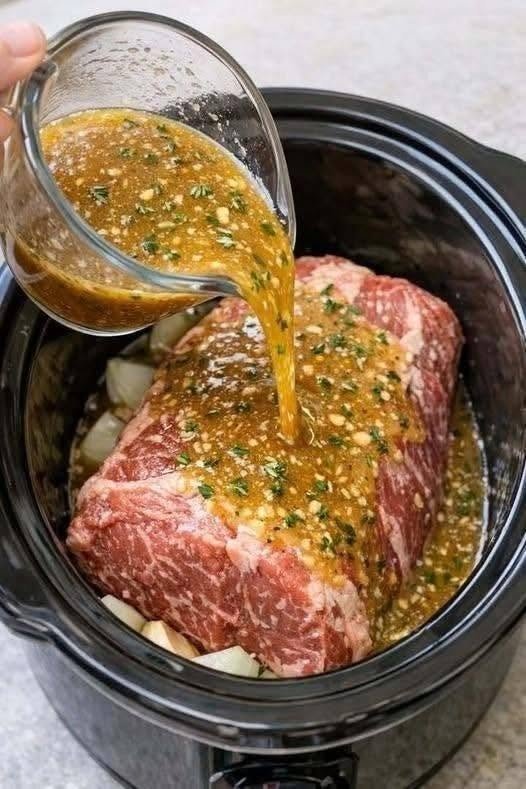
This Slow Cooker Maple Dijon Beef Roast transforms a chuck roast into a fork-tender centerpiece. Braised low and slow in a sweet and tangy glaze of pure maple syrup, Dijon mustard, Worcestershire sauce, and garlic, this low-effort roast pairs with mashed potatoes, egg noodles, or steamed rice.
Equipment & Ingredients
Component Breakdown
Section Ingredient Quantity Functional & Culinary Role
Beef Foundation Beef chuck roast 3–4 lbs (1.4–1.8 kg) Collagen-rich cut that renders into tender meat during slow braising.
Fine sea salt & black pepper 1 tsp salt, ½ tsp pepper Seasons muscle fibers and enhances meat flavor.
Braising Matrix Pure maple syrup ½ cup (120ml) Deep, woody sweetness (substitute honey if unavailable).
Dijon mustard ¼ cup (60g) Sharp, acidic tang that cuts through rich meat fats.
Beef broth 1 cup (240ml) Essential liquid base for thermal braising.
Worcestershire sauce 1 tbsp (15ml) Complex savory umami booster.
Garlic 2 cloves, minced Primary aromatic catalyst.
Thickening Slurry Cornstarch & Cold water 2 tbsp each Cold emulsion that thickens hot braising liquid into a glossy gravy.
🧪 Food Science: Collagen Gelatinization & Slurry Chemistry
Chuck Roast Collagen Hydrolysis: Chuck roast contains heavy deposits of tough collagen (connective tissue). When held at low temperatures ($160^\circ\text{F}\text{–}180^\circ\text{F}$) over 8 to 10 hours, collagen hydrolyzes into soluble gelatin. Gelatin lubricates individual muscle fibers, converting a tough cut into a juicy, shreddable roast.
Low vs. High Thermal Kinetics: Cooking on LOW allows collagen to liquefy before muscle proteins contract excessively. Cooking on HIGH causes protein fibers to rapidly shrink and squeeze out intracellular water before collagen can convert to gelatin, resulting in tough, stringy meat.
Cold Slurry Starch Gelatinization: Adding dry cornstarch directly to hot liquid causes surface granules to instantly gelatinize and clump around raw starch centers. Pre-mixing cornstarch with cold water creates a uniform suspension that disperses evenly into the simmering sauce before swelling and thickening at $180^\circ\text{F}\text{–}200^\circ\text{F}$.
Step-by-Step Instructions:
LOOK NEXT PAGE DEAR──►
For Complete Cooking STEPS Please Head On Over To Next Page Or Open button (>)